

The global water crisis and climate change are forcing industrial facilities to fundamentally reshape their water use strategies. For a modern business today, water is not just an input but one of the most critical risk factors that must be managed. At this point, the question of what is zero liquid discharge stands at the forefront for professionals seeking both environmental compliance and operational efficiency. Zero Liquid Discharge (ZLD) is a revolutionary engineering approach that keeps wastewater within a completely closed loop inside the facility instead of discharging it into nature.
Quick Summary: ZLD Technology
Zero Liquid Discharge (ZLD) is the recovery of all wastewater generated at the end of an industrial process through advanced treatment techniques, ensuring no liquid waste is released from the system. Consequently, only solid waste remains, and 95-99% of the water is returned to the process.
- Up to 90% reduction in water consumption costs
- 100% compliance with legal discharge limits and environmental regulations
- Dramatic increase in sustainability and ESG scores
- Recovery of valuable minerals and salts from wastewater
What is Zero Liquid Discharge (ZLD)?
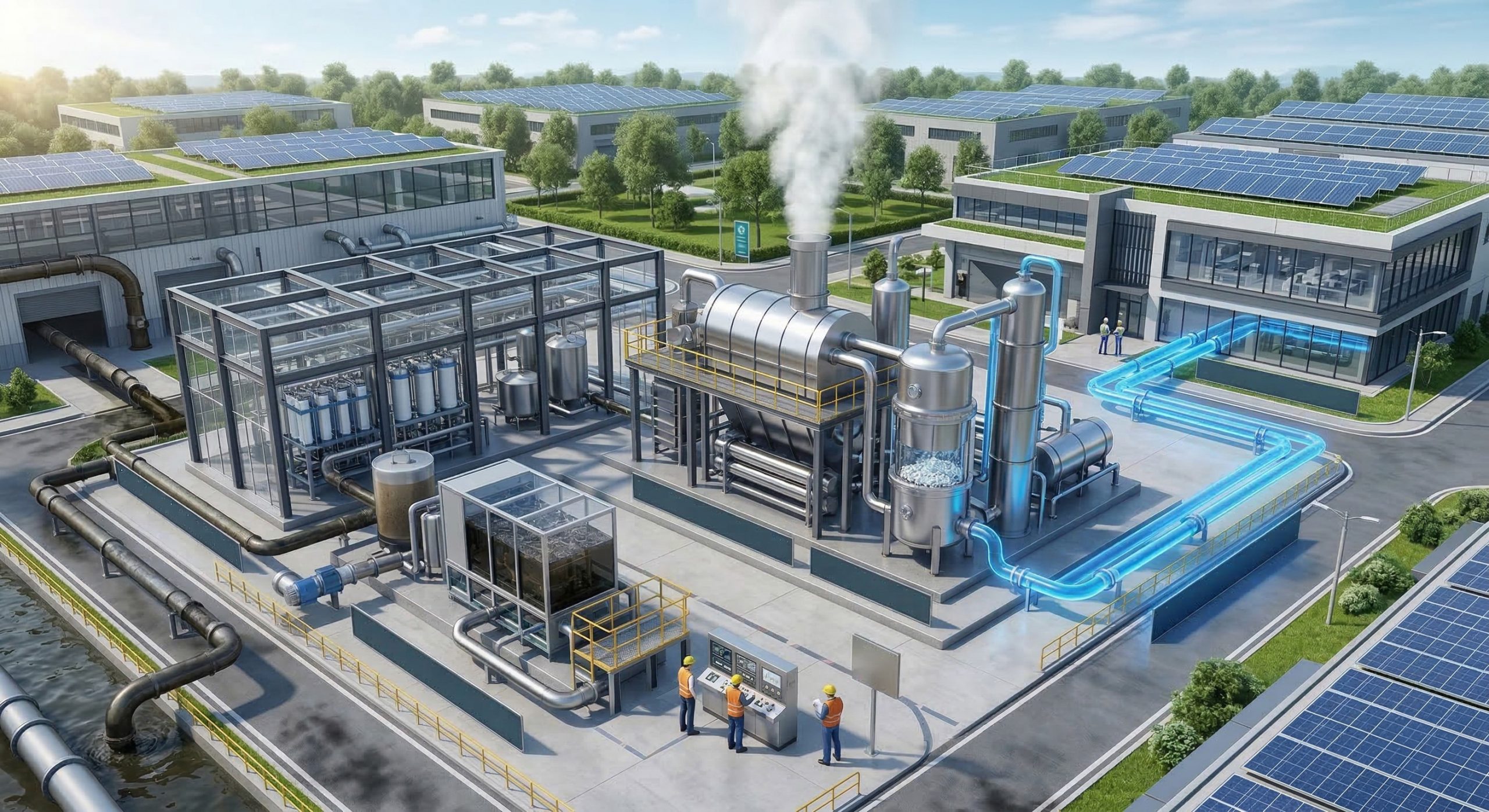
From a technical perspective, what is zero liquid discharge is an advanced water treatment process that completely closes a facility's water cycle. While traditional treatment systems treat water to a certain quality and discharge it into receiving environments such as rivers, lakes, or sewers; ZLD systems recover the entire liquid component by taking the water through evaporation and crystallization stages.
This process not only prevents environmental pollution but also maximizes the value of water as a "raw material." According to United Nations Water Report data, industrial water efficiency is among the most critical strategies to play a role in closing the global water gap by 2030.
Working Principle of ZLD Systems: Step-by-Step Process
ZLD is not a single device but an integrated set of systems. Although the wastewater characterization of every business is different, a standard application usually consists of these three main stages:
1. Pre-treatment and Concentration
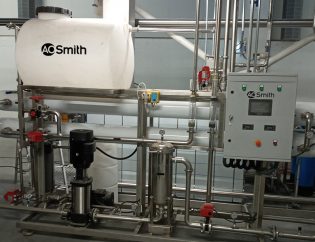
Wastewater first undergoes physical and chemical pre-treatment. Suspended solids and organic pollutants are removed. Then, using high-pressure membrane systems such as Reverse Osmosis (RO), a large portion of the water is recovered, and the remaining wastewater is turned into "concentrated brine."
2. Thermal Evaporation
The brine, which membrane systems can no longer concentrate, is sent to thermal evaporators. Here, water is evaporated and recovered as distilled water, while the waste volume significantly shrinks.
3. Crystallization
In the final stage, the supersaturated waste enters a crystallizer. Here, the last drops of water are recovered, leaving behind only dry crystals (salts) ready for disposal or use as industrial raw materials.
To reduce energy costs in ZLD installations, MVR (Mechanical Vapor Recompression) technology should be preferred. This technology can reduce energy consumption by 50-70% compared to traditional systems by utilizing the latent heat of the vapor.
Advantages of ZLD Systems: Why Invest?
For businesses, the advantages of ZLD systems are not just about conscientious environmentalism; they are directly related to profitability and risk management.
| Advantage Category | Description | Impact Level |
|---|---|---|
| Regulatory Compliance | Provides exemption from all environmental fines and restrictions thanks to "Zero Discharge." | Critical |
| Water Security | Ensures continuity of production during drought periods by reducing dependence on mains water. | High |
| Cost Efficiency | Provides significant savings in raw water intake and wastewater discharge taxes. | High |
| Brand Value | Provides a competitive advantage in the international market with the "Water Positive" business title. | Strategic |
Benefits of Industrial Wastewater Recovery and Economic Returns
When analyzing the benefits of industrial wastewater recovery, it is observed that the return on investment (ROI) period varies between 3 to 7 years depending on the unit price of water. Especially in water-intensive sectors such as textiles, mining, power plants, and the chemical industry, the quality of recovered water is often higher than that of mains water. This increases process efficiency and extends equipment life.
A chemical plant producing 2,000 m³ of wastewater daily saved approximately $800,000 annually in water expenses after a ZLD investment. Furthermore, the sale of industrial salt recovered during the crystallization stage covered 15% of the system's annual operating costs.
Application Areas of Zero Liquid Discharge
ZLD systems today are not just a necessity but a symbol of prestige and efficiency. The main zero liquid discharge application areas include:
- Power Plants: Management of tower blowdown water and flue gas desulfurization wastes.
- Textiles and Dyehouses: Recovery of water and salt from dye baths.
- Oil and Gas: Treatment of produced water for re-injection or reuse.
- Food and Beverage: Treatment of highly polluted water from factory cleaning processes (CIP).
Common Mistakes in Practice and Solutions
The biggest reason for failure in ZLD projects is incorrect wastewater characterization. A design that does not account for seasonal variations and peak production times can cause membrane fouling or skyrocketing energy costs.
Error: Technology-Focused Design
Instead of focusing solely on purchasing equipment, one should start with a "Water Audit" that includes the entire life cycle of water.
Solution: Pilot Studies
Conducting a 3-6 month pilot plant study with real wastewater samples before a large-scale investment minimizes risks.
Future Trend: Smart ZLD Systems
Artificial Intelligence and IoT integration are transforming ZLD systems into "self-optimizing" structures. Water content is monitored instantly via sensors, and chemical dosing and energy consumption are automatically adjusted accordingly. In the future, even city sewage systems are expected to operate with regional ZLD units, using water in a 100% closed loop.
Frequently Asked Questions
Yes, but economic feasibility depends on water costs, discharge bans, and wastewater volume. For small-scale facilities, "LLD" (Low Liquid Discharge) models may be more suitable.
The initial capital expenditure (CAPEX) is high. However, operating expenses (OPEX) are balanced by factors such as water savings and fine prevention, turning it into a profitable investment in the medium term.
The remaining solid waste is usually a mixture of salts and minerals. In some cases, these salts can be purified and sold on the market; otherwise, they are sent to licensed waste disposal facilities.
The thermal stage, the heart of the system, is energy-intensive. However, this consumption is minimized with modern evaporators and heat recovery technologies.
Conclusion
Zero Liquid Discharge (ZLD) is not just an environmental choice but a survival strategy in the competitive business world of the 21st century. In a world where water resources are dwindling and legal regulations are tightening, viewing wastewater as a resource rather than a burden adds both prestige and financial strength to your business.
- What is ZLD? It is the zeroing of liquid discharge by recovering 100% of wastewater.
- Key Advantage: Regulatory compliance, water savings, and operational sustainability.
- Critical Technology: Combination of membrane concentration, evaporation, and crystallization.